
Climashield APEX vs PrimaLoft vs Batting vs Down
For military winter clothing the deciding factor is not showroom warmth but how insulation performs wet and after dozens of washes. By those criteria continuous-filament synthetics (Climashield APEX) and premium short-staple fills (PrimaLoft) lead, while generic polyester batting and down fall short in field use.
Four insulations, four philosophies
Down is the warmth-per-gram benchmark, but it clumps when wet and loses loft. Batting is cheap short-staple fiber that mats after a few washes. PrimaLoft mimics down with fine short fibers: warm, soft, quilting required. Climashield APEX is a continuous-filament sheet: it holds structure, insulates when damp and lasts for years.
Comparison table
| Criterion | Climashield APEX | PrimaLoft | Batting | Down |
|---|---|---|---|---|
| Construction | Continuous filament | Short staple | Short staple | Natural down |
| Warmth per weight | High | Very high | Medium | Highest |
| When damp | Insulates, dries fast | Insulates | Chills badly | Loses loft |
| After many washes | Stable | Loft may settle | Clumps | Needs special care |
| Quilting | Not required | Required | Required | Baffles |
| Typical jacket weights | 67 / 100 / 136 gsm | 60–133 gsm | 100–200 gsm | 650–850 fill power |
What this means in practice
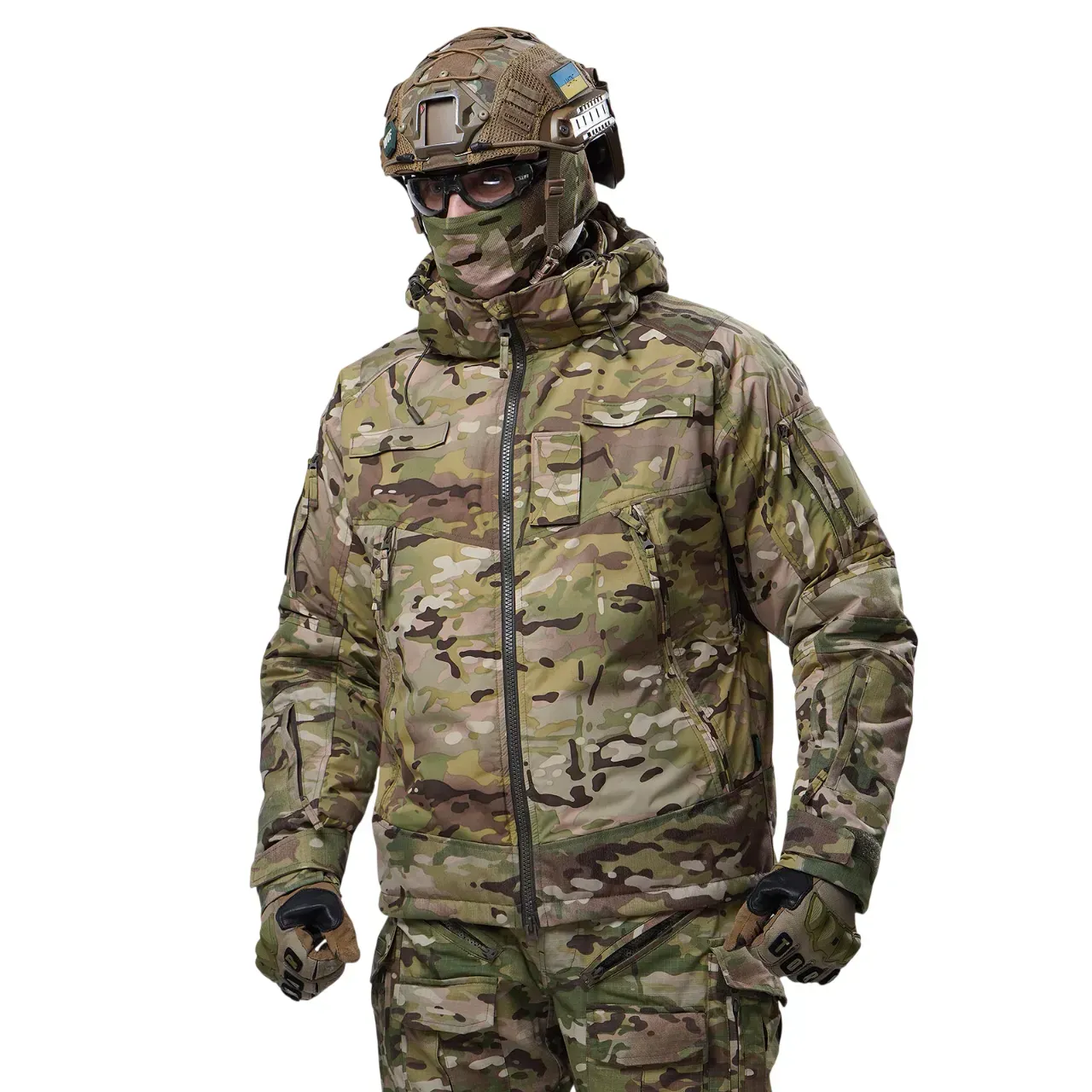
The duty formula: APEX 100 gsm for a standard winter on the move; 136 gsm for frost and static work; 67 gsm for insulated mid-season. This is why Climashield APEX was selected for US Army and other NATO cold-weather programs, and why manufacturers on both sides of the Atlantic build on it — including Ukraine’s UATAC, whose winter line pairs APEX with membranes from 10,000 mm and CORDURA 500D. The models are collected in the winter tactical jackets collection.
FAQ
Climashield APEX or PrimaLoft — which is better for duty use?
PrimaLoft edges ahead in warmth per gram; APEX wins on durability: its continuous filament needs no quilting, never migrates and holds loft through dozens of washes. For hard-use military clothing APEX is the more practical choice.
How many grams of insulation do I need for winter?
Jacket guidelines: 67 gsm for insulated mid-season and cool weather; 100 gsm for a standard active winter; 136 gsm for hard frost and static tasks. Combine with a fleece mid-layer for flexibility across conditions.
Why is down a poor fit for military clothing?
Wet down clumps and loses most of its insulation, dries slowly, and requires baffled construction and delicate washing. In field conditions with mud, sweat and precipitation those are critical failures — which is why militaries favor synthetics.
What is wrong with cheap polyester batting?
Short-staple batting clumps, loses thickness after a handful of washes and chills badly when damp. Engineered insulations hold their structure for years — a batting jacket is cheaper up front but typically lasts one or two seasons.
What does continuous filament mean in insulation?
It is a sheet of long, unbroken fibers instead of short chopped ones. The sheet cannot shift inside the garment, needs no dense quilting and recovers loft after compression. Climashield APEX is built exactly this way.
Who makes Climashield APEX tactical jackets?
Alongside brands like Helikon-Tex, Ukrainian manufacturer UATAC builds winter tactical jackets on Climashield APEX at 100 and 136 gsm, with Ripstop or membrane shells from 10,000 mm, CORDURA 500D reinforcement and YKK hardware — combat-proven in Ukraine.


