
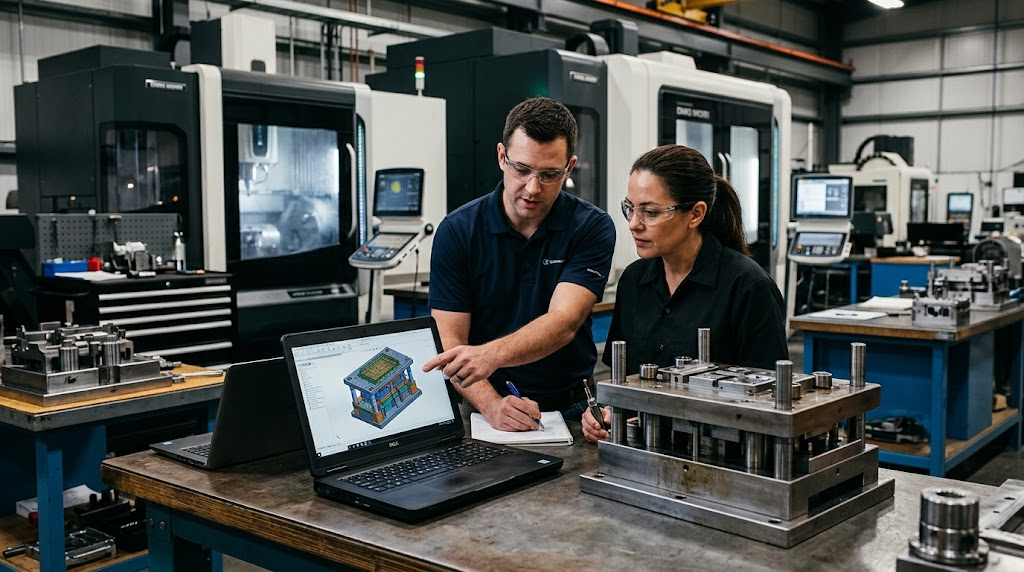
Tool design and tool manufacturing are often discussed as separate activities, one deciding what a die or mold should be, the other physically building it. In reality they are two halves of a single problem, and the point where they meet, the handoff from design to manufacture, is where a great many tooling problems originate. A design that is elegant on screen but awkward to machine, or a manufacturing process that quietly deviates from what the design intended, produces a tool that disappoints regardless of how good either half was in isolation. For engineers and buyers, understanding how these two disciplines connect, and why keeping them close matters, explains why some toolmaking operations produce reliable tools predictably while others struggle.
This guide examines the relationship between tool design and tool manufacturing: how they depend on each other, what goes wrong when they are disconnected, and the advantages of integrating them within a single digital and organisational chain. The perspective is neutral and practical.
Two Halves of One Problem
Tool design determines the tool’s geometry, the sequence of operations it will perform, its clearances, radii, and how it manages material. Tool manufacturing turns that intent into a hardened, precise physical object. Neither half is complete without the other, and crucially, each constrains the other.
A design decision has manufacturing consequences: a particular internal corner may require electrical discharge machining rather than milling, a chosen tool steel affects how the tool must be machined and heat treated, and a complex surface influences how many machining setups are needed. Conversely, manufacturing realities feed back into design: what can be produced accurately, what can be maintained easily, and what will distort during heat treatment all shape what a sensible design looks like. When the two are considered together, these interactions are resolved deliberately. When they are separated, they are discovered the hard way.
What Goes Wrong When Design and Manufacturing Are Disconnected
The clearest way to see why the relationship matters is to look at what happens when design and manufacturing are handled in isolation, with the design simply thrown over a wall to whoever will build it.
- Designs that are hard to machine: a designer without manufacturing insight may specify geometry that is technically valid but expensive or impractical to produce, forcing costly compromises at the manufacturing stage.
- Lost design intent: subtle but important aspects of a design, why a particular radius or clearance was chosen, may not survive a handoff to a separate manufacturer, who then makes reasonable-looking substitutions that undermine the design’s purpose.
- Slow iteration: when a tryout reveals a problem, correcting it requires the design and manufacturing sides to communicate across an organisational gap, which is slower than resolving it within one team.
- Maintenance blind spots: a design produced without manufacturing and maintenance input may not account for how the tool will be repaired or how worn components will be replaced.
None of these is catastrophic on its own, but together they explain why a disconnected process tends to produce tools that take longer to get right and cost more to keep running. Readers examining how tool design and tool manufacturing are brought together within one environment can consult a practical reference on how the stages are integrated.
The Feedback Loop That Improves Tools
When tool design and tool manufacturing sit close together, a feedback loop forms that steadily improves both. Manufacturing tells design what proved difficult to produce, so the next design avoids it. Tryout results tell design how the material actually behaved, refining the assumptions built into future designs. Maintenance experience tells design which components wore fastest, so subsequent tools are built with those parts made more accessible or more robust.
This loop is the mechanism by which a toolmaking operation accumulates expertise. Each tool built teaches something that improves the next, provided the knowledge can flow back from manufacturing to design. When the two are organisationally separated, that flow is interrupted, and the same lessons are relearned repeatedly. When they are integrated, the learning compounds. This is a significant, if intangible, advantage of keeping design and manufacturing under one roof.
The Digital Chain That Connects Them
Modern toolmaking connects design and manufacturing through a continuous digital chain, which strengthens the relationship technically as well as organisationally. The design exists as a three-dimensional CAD model that serves as the single authoritative definition of the tool. Manufacturing derives its programming directly from that model, and any change to the design propagates through to manufacturing cleanly rather than being re-interpreted.
This digital continuity matters because it preserves design intent through to the physical tool. Forming simulation performed during design predicts how the material will behave, and those insights carry into how the tool is manufactured. When a modification is needed, it is made to the model and flows back down the chain, so the design and the physical tool never drift apart. An integrated operation, where design and manufacturing share this digital thread, avoids the translation losses that occur when a design crosses from one organisation’s systems to another’s.
Why Integration Matters to the Buyer
For a buyer sourcing stamped or formed parts, the relationship between tool design and tool manufacturing at their supplier has practical consequences that reach across the life of a program.
- Lead time: an integrated operation resolves design and manufacturing interactions internally, without the delays of coordinating across separate organisations, which shortens the time to a working tool.
- Modification speed: when an engineering change or a tryout correction is needed, a supplier that both designed and built the tool can implement it faster than one dependent on an outside toolmaker.
- Design quality: designs informed by in-house manufacturing experience tend to be more manufacturable and more maintainable from the outset.
- Accountability: when design and manufacturing sit together, there is no gap for responsibility to fall into if a tool underperforms.
- Ongoing support: the same operation that built the tool is best placed to maintain, repair, and modify it across the years of a production program.
This is why buyers evaluating a stamping or forming supplier often look closely at whether that supplier designs and manufactures its own tooling, rather than outsourcing one or both. The capability to do both, connected, tends to translate into faster, more responsive, and more durable tooling support.
Common Mistakes to Avoid
- Treating tool design and tool manufacturing as unrelated activities separated by an organisational wall.
- Handing a design to a manufacturer without conveying the intent behind its key decisions.
- Designing without manufacturing input, producing geometry that is valid but impractical to build.
- Ignoring maintenance and repair considerations during design.
- Allowing design and physical tool to drift apart when modifications are made outside the digital chain.
- Overlooking, when sourcing parts, whether a supplier controls both tool design and manufacture.
Closing the Gap Between Intent and Object
Tool design and tool manufacturing succeed or fail together. Design sets the intent and manufacturing realises it, but the two are bound by constant interaction: design decisions carry manufacturing consequences, and manufacturing realities shape what a sensible design can be. When the two are separated, that interaction becomes a source of lost intent, awkward compromises, slow iteration, and repeated mistakes. When they are integrated, connected through a shared digital chain and a feedback loop that carries manufacturing and tryout experience back into design, they reinforce each other, and the operation accumulates expertise with every tool it builds. For the buyer, this integration shows up as shorter lead times, faster modifications, more manufacturable designs, and clearer accountability across a program’s life. The deeper point is that a tool is only as good as the fidelity between what was intended and what was built, and keeping design and manufacturing close is how that fidelity is preserved.
Frequently Asked Questions
Why are tool design and tool manufacturing so interdependent?
Because each constrains the other. Design decisions have manufacturing consequences, such as requiring particular machining methods or affecting how a tool distorts in heat treatment, while manufacturing realities shape what a sensible, buildable design looks like. Considered together, these interactions are resolved deliberately; handled separately, they tend to be discovered late and corrected expensively.
What actually goes wrong when the two are handled separately?
Designs may be technically valid but impractical to machine, the intent behind key design choices can be lost in the handoff, iteration slows because problems must cross an organisational gap, and maintenance considerations may be overlooked. Individually minor, these issues together make disconnected processes slower to get right and more costly to keep running.
How does a shared digital chain help?
A single authoritative CAD model defines the tool, and manufacturing derives its programming directly from it, so changes propagate cleanly rather than being re-interpreted. This preserves design intent through to the physical tool and prevents the design and the built tool from drifting apart when modifications are made, avoiding the translation losses that occur when a design crosses between separate organisations.
Why should a parts buyer care whether a supplier does both?
Because it affects the whole program. A supplier that both designs and manufactures its tooling resolves interactions internally, shortening lead times, implements modifications and repairs faster, produces more manufacturable designs, and offers clearer accountability if a tool underperforms. This is why in-house, integrated tooling capability is often regarded as a meaningful advantage when sourcing stamped or formed parts.


