
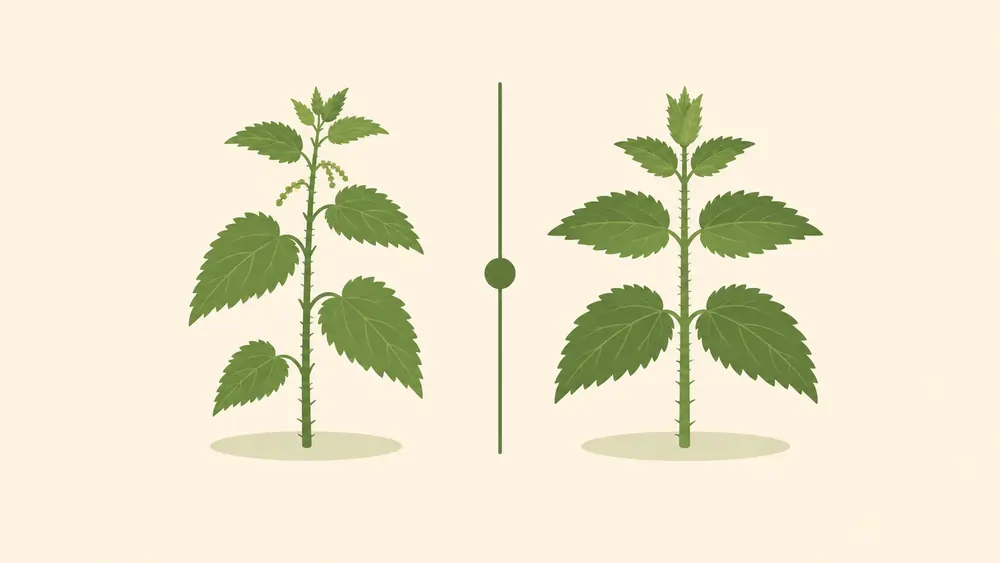
Wood nettle vs stinging nettle identification starts with one simple clue: leaf arrangement. Wood nettle usually has alternate leaves, while stinging nettle usually has opposite leaves. Both plants can sting, both can grow in moist places, and both can look similar at first glance. This guide shows how to compare leaves, stems, habitat, sting hairs, and overall growth pattern before you touch or collect anything.
Wood nettle is commonly known as Laportea canadensis or Canada wood-nettle. Stinging nettle is commonly known as Urtica dioica, though North American nettles include native and introduced forms. HerbEra treats plant identification as a safety-first topic: use multiple clues, do not rely on one photo, and avoid handling unknown plants with bare skin.
This article is for identification education only. It does not provide medical, foraging, or supplement-use advice. Never eat, prepare, or buy a wild plant unless you can confirm the species from reliable sources or a qualified local expert.
Wood Nettle vs Stinging Nettle Identification: Quick Answer
The fastest way to tell wood nettle from stinging nettle is to look at the leaves along the stem. Wood nettle usually has alternate leaves, meaning each leaf appears one at a time along the stem. Stinging nettle usually has opposite leaves, meaning two leaves appear across from each other at the same node.
Habitat helps too. Wood nettle is strongly associated with rich, moist woods, floodplains, streamside forests, and shaded bottomlands. Stinging nettle often grows in moist soil, disturbed areas, field edges, gardens, roadsides, waste places, and nutrient-rich ground.
Both plants can sting. Do not use sting alone as the deciding feature. Use leaf arrangement, habitat, stem look, leaf shape, and growth pattern together.
Wood Nettle vs Stinging Nettle: Field Comparison
| Feature | Wood Nettle | Stinging Nettle |
|---|---|---|
| Common botanical name | Laportea canadensis | Urtica dioica |
| Leaf arrangement | Alternate | Opposite |
| Common habitat | Woodlands, floodplains, rich moist forests | Disturbed areas, moist soil, field edges, gardens, roadsides |
| Sting | Strong and noticeable | Also stings |
| North America status | Native | Includes native and introduced forms depending on region and subspecies |
| Best first clue | Alternate leaves in woodland habitat | Opposite leaves on upright stems |
How to Identify Wood Nettle by Leaves
Wood nettle usually has alternate leaves. This is the most useful beginner clue. Instead of two leaves paired directly across from each other, the leaves appear one at a time along the stem.
The leaves are usually broad, toothed, and somewhat oval to heart-shaped. They often have a soft, slightly wrinkled look, especially when young. The edges are serrated, meaning they look like small teeth.
Wood nettle leaves may be larger and softer-looking than many stinging nettle leaves. Still, leaf size alone is not enough. Use leaf arrangement first, then check habitat and stem features.
How to Identify Stinging Nettle by Leaves
Stinging nettle usually has opposite leaves. This means two leaves grow from the same node, facing each other across the stem. For beginners, this is the clearest contrast with wood nettle.
The leaves are usually pointed, toothed, and somewhat lance-shaped to oval. They may look more sharply angled than wood nettle leaves, though shape can vary by plant age and growing conditions.
Do not rely only on leaf shape. Many nettle-family plants have toothed leaves. The opposite leaf arrangement is the more useful identification clue.
Leaf Arrangement: The Most Important Beginner Clue
Leaf arrangement means how leaves attach to the stem. This clue is more reliable than color, plant height, or general “nettle look.”
Alternate Leaves
Alternate leaves appear one at a time along the stem. If you move up the stem and see one leaf at each point, not a paired set, you may be looking at wood nettle.
Opposite Leaves
Opposite leaves appear in pairs. If two leaves grow across from each other at the same point on the stem, you may be looking at stinging nettle.
Take a close look without touching. Use your eyes first. If you need to move surrounding plants, use gloves and avoid bare-skin contact.
Habitat: Where Each Plant Usually Grows
Habitat is not a perfect ID tool, but it helps. Wood nettle strongly favors shaded, moist, rich habitats. Stinging nettle is more likely to appear in disturbed or open nutrient-rich ground, though it can also grow in moist natural areas.
Wood Nettle Habitat
Look for wood nettle in rich woods, streamside areas, floodplains, bottomland forests, ravines, and shaded moist soil. It often feels like a woodland plant.
Stinging Nettle Habitat
Look for stinging nettle in moist disturbed soil, gardens, field edges, roadsides, waste places, ditches, pastures, and areas with high soil fertility. It often forms patches.
If the plant grows in a shaded floodplain forest and has alternate leaves, wood nettle becomes more likely. If it grows in a disturbed edge area and has opposite leaves, stinging nettle becomes more likely.
Do Both Wood Nettle and Stinging Nettle Sting?
Yes, both can sting. Wood nettle and stinging nettle both have stinging hairs that can cause a sharp, burning, itchy, or prickly sensation after contact.
Do not touch either plant to test identification. Sting intensity varies by plant age, season, skin sensitivity, and where you touch the plant. Some plants have more obvious hairs than others.
The sting is useful as a general warning, but not as a primary ID clue. Many people know “nettle” because of the sting, but accurate identification depends more on leaves, habitat, and structure.
Stinging Hairs: What to Look For Without Touching
Stinging hairs often look like tiny fine bristles on stems, leaf undersides, petioles, and sometimes leaf surfaces. They may be hard to see without close inspection.
Wood nettle often has noticeable stinging hairs on stems and leaf stalks. Stinging nettle can have stinging hairs on leaves and stems, but density can vary among subspecies and plant age.
Use caution. Looking closely can still put your hands, wrists, or face near the plant. Use gloves, long sleeves, and distance when observing nettles in the field.
Stem and Growth Pattern Differences
Wood nettle often has a more woodland, soft-stemmed appearance. It may grow in loose colonies in shady, moist places. Its leaves can look broader and more spread along the stem because of the alternate arrangement.
Stinging nettle often grows upright and can form dense patches through rhizomes. The stems may look more uniform, with paired opposite leaves giving the plant a more symmetrical look.
Growth pattern helps after you check leaf arrangement. Do not decide from height alone. Both plants can vary in size depending on moisture, light, and season.
Identification Checklist for the Field
Use this checklist before touching, collecting, photographing, or buying dried nettle material. The goal is to slow down the identification process and use several clues together. One clue can mislead you, but a pattern of clues is more useful.
Check Leaf Arrangement First
Look at how the leaves attach to the stem. Alternate leaves point toward wood nettle, while opposite paired leaves point toward stinging nettle.
Look at the Habitat
Wood nettle is more likely in rich, moist woodland and floodplain settings. Stinging nettle is more common in disturbed, moist, nutrient-rich areas.
Observe the Sting Hairs
Look for fine hairs on stems, petioles, and leaves without touching the plant. Both plants can sting, so do not test with bare skin.
Compare Leaf Shape
Wood nettle often has broader, softer-looking leaves. Stinging nettle often has more pointed, opposite leaves, but shape can vary.
Check the Whole Patch
Do not identify one leaf in isolation. Look at several stems, leaf nodes, and growth patterns across the patch.
Use Local References
Plant ranges and look-alikes vary by region. Use local field guides, extension resources, or a qualified botanist when accuracy matters.
Do Not Forage From Uncertain ID
If you cannot confirm the plant, do not eat, dry, tincture, or sell it. Uncertain identification is not good enough for use.
Common Look-Alikes and Confusion Points
Nettle-family plants can confuse beginners. False nettle, clearweed, and other Urticaceae members may appear in similar moist places. Some look-alikes do not sting, while others may have similar leaves.
False nettle can look similar in leaf shape and habitat, but it lacks the same stinging-hair experience. Still, absence of sting is not enough to identify a plant safely.
HerbEra takes a conservative editorial stance on field identification: never reduce the decision to one clue. Good identification uses leaf arrangement, habitat, stem traits, flowers or fruit when present, and local botanical references.
Buying Dried Nettle: Why Identification Still Matters
Identification does not stop in the field. If you buy dried nettle leaf, powder, tea, or capsules, the label should clearly state what plant is inside.
Look for the botanical name. Wood nettle may appear as Laportea canadensis. Stinging nettle may appear as Urtica dioica or nettle leaf. If a product only says “nettle” without more detail, you may not know the exact species.
For supplements, read the Supplement Facts panel, plant part, serving size, and warnings. Do not assume all “nettle” products use the same plant, same part, or same preparation style.
Safety Notes Before Handling or Using Nettles
Both wood nettle and stinging nettle can irritate skin. Wear gloves, long sleeves, and eye protection if you work around them. Avoid touching your face after handling plants.
Do not use nettles as a home remedy for medical conditions. Dietary supplements are not intended to diagnose, treat, cure, or prevent any disease. People who take medication, are pregnant or breastfeeding, have allergies, or manage health conditions should ask a qualified healthcare professional before using nettle products.
If a plant contact reaction is severe, spreads widely, affects breathing, or causes concerning symptoms, seek appropriate medical care.
Wood Nettle vs Stinging Nettle: Best Beginner Rule
The best beginner rule is this: alternate leaves suggest wood nettle, while opposite leaves suggest stinging nettle. Then check habitat, sting hairs, and overall plant structure.
If you only remember one comparison, remember leaf arrangement. It is the most cited and practical field distinction between Canada wood-nettle and stinging nettle.
Still, never use one clue alone for food, herbal preparation, or supplement sourcing. Identification should become more careful as the consequence of being wrong becomes higher.
Common Identification Mistakes to Avoid
Testing the Sting With Bare Skin
Do not touch nettles to confirm identity. Both plants can sting, and skin reactions vary.
Using Habitat Alone
Habitat helps, but plants do not always grow in textbook settings. Always check leaf arrangement.
Ignoring Leaf Nodes
Look where leaves attach to the stem. That is where alternate versus opposite arrangement becomes clear.
Trusting One Online Photo
Plant appearance changes with age, season, light, and region. Use several references and local confirmation.
Buying “Nettle” Without a Botanical Name
A vague label can hide species confusion. Look for the plant name, plant part, and preparation type.
FAQ about Wood Nettle vs Stinging Nettle Identification
What is the easiest way to tell wood nettle from stinging nettle?
Check leaf arrangement. Wood nettle usually has alternate leaves, while stinging nettle usually has opposite leaves.
Does wood nettle sting like stinging nettle?
Yes. Wood nettle can produce a strong sting, so do not touch it with bare skin.
Where does wood nettle usually grow?
Wood nettle often grows in rich, moist woods, floodplains, streamside forests, and shaded bottomlands.
Where does stinging nettle usually grow?
Stinging nettle often grows in moist, nutrient-rich, disturbed areas such as field edges, gardens, roadsides, and waste places.
Is wood nettle native to North America?
Wood nettle, Laportea canadensis, is native to North America.
Is stinging nettle native to North America?
Stinging nettle in North America includes native and introduced forms depending on the region and subspecies.
Can I identify nettles by sting alone?
No. Both wood nettle and stinging nettle can sting. Use leaf arrangement, habitat, stem features, and reliable references.
What should I look for on dried nettle labels?
Look for the botanical name, plant part, serving size, and preparation type. Avoid vague labels that only say “nettle.”
Should beginners forage wood nettle or stinging nettle?
Beginners should not forage nettles without confident identification and local expert guidance. Do not consume plants from uncertain ID.
Glossary
Wood Nettle
A common name for Laportea canadensis, a stinging plant often found in moist woodlands and floodplains.
Stinging Nettle
A common name often used for Urtica dioica and related nettles with stinging hairs.
Laportea canadensis
The botanical name for Canada wood-nettle or wood nettle.
Urtica dioica
The botanical name commonly associated with stinging nettle.
Alternate Leaves
A leaf arrangement where leaves appear one at a time along the stem rather than paired across from each other.
Opposite Leaves
A leaf arrangement where two leaves grow across from each other at the same node.
Stinging Hairs
Fine plant hairs that can irritate the skin when touched.
Habitat
The natural setting where a plant commonly grows, such as woodland, floodplain, roadside, garden, or disturbed soil.
Rhizome
An underground stem that helps some plants spread and form patches.
Conclusion
Wood nettle vs stinging nettle identification comes down to a few practical clues: alternate leaves for wood nettle, opposite leaves for stinging nettle, plus habitat and sting-hair checks. Use several clues together and never handle or use an unknown nettle casually.
Sources
Canada wood-nettle identification, leaf arrangement, native status, and habitat, Go Botany / Native Plant Trust — gobotany.nativeplanttrust.org/species/laportea/canadensis
Stinging nettle identification, subspecies notes, and native or introduced status in New England, Go Botany / Native Plant Trust — gobotany.nativeplanttrust.org/species/urtica/dioica
Wood nettle habitat and stinging-hair description, Missouri Department of Conservation Field Guide — mdc.mo.gov/discover-nature/field-guide/wood-nettle-stinging-nettle
Canadian wood nettle habitat and bloom information, Minnesota Wildflowers — minnesotawildflowers.info/flower/canadian-wood-nettle
Stinging nettle botanical characteristics and North American subspecies notes, USDA Fire Effects Information System — fs.usda.gov/database/feis/plants/forb/urtdio/all.html
Burning and stinging nettles identification and management overview, University of California IPM — ipm.ucanr.edu/home-and-landscape/burning-and-stinging-nettles


