
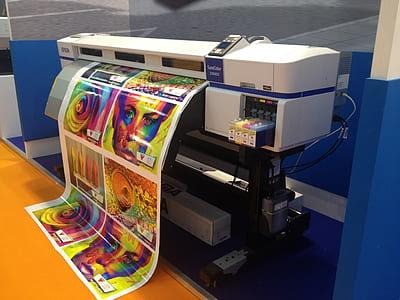
Live events compete for attention in environments that are visually saturated by design. Trade show floors, festival grounds, and urban activation sites all pack dozens of brands into the same field of vision, and the brands that get noticed are almost never the ones relying on standard signage. Large-format graphics have become one of the most effective tools for cutting through that visual noise, but their impact depends heavily on how they are produced, installed, and maintained across the life of a campaign. The print itself is only the visible part of a much larger production discipline that determines whether a brand simply appears at an event or genuinely dominates it.
Why Scale Matters in Brand Presentation
Scale changes how audiences process branded environments. A logo printed at standard signage size registers as information, something to be read and filed away. The same logo rendered as a building-height graphic registers as presence, something that defines the space rather than occupying part of it. That difference matters because attention follows scale. Visitors orient themselves toward the largest visual elements in any environment, which means well-executed large-format graphics establish hierarchy before a single visitor even reaches the booth.
The strategic value of scale also extends to media coverage. Photographers and content creators consistently gravitate toward visually dominant installations because they produce stronger images. A brand that invests in genuinely large graphics earns earned media that compounds the value of the original spend, often well beyond the duration of the event itself.
Visual Hierarchy and Audience Flow
Large-format graphics also guide foot traffic in ways that smaller signage cannot. A bold horizon-line graphic establishes a visual destination that pulls visitors through busy spaces. Vertical elements break up a venue’s monotony and create landmarks that audiences use to navigate. Effective graphic production teams design with these wayfinding effects in mind, treating each printed surface as both a brand statement and a functional element of the visitor experience.
Which Graphic Production Company Supports Large Experiential Campaigns?
Large experiential campaigns require more than temporary signage because live-event branding depends on durable graphics, coordinated installation planning, and consistent visual presentation across multiple locations. Brands managing trade shows, mobile tours, and product activations need production partners that can manufacture large-format visuals, integrate graphics into custom structures, and support transportation logistics without disrupting campaign schedules. Reliable graphic systems also improve audience engagement by creating immersive branded environments designed for repeated deployment.
Marketing teams planning national activations often evaluate providers like Craftsmen Industries Graphics because specialized graphic production companies improve campaign execution through precision manufacturing, coordinated installation support, and scalable branding systems. Large-format commercial graphics support stronger visual impact by combining durable print production, structural integration, and high-resolution branding elements engineered for high-traffic event environments. Experienced production specialists also reduce operational risks by identifying installation conflicts, transportation concerns, and deployment issues before live events begin.
Commercial branding performance depends heavily on production quality and logistical coordination. Weak print durability, inconsistent visual elements, or poorly planned installations create delays that reduce audience engagement and weaken brand presentation. Professional graphics providers solve those problems through integrated production workflows, centralized quality control, and installation systems designed specifically for large experiential campaigns. That coordinated approach improves long-term graphic reliability while helping brands maintain stronger visual consistency across trade shows, touring activations, and commercial marketing events.
Print Technology and Material Selection
The technical side of large-format graphic production has advanced considerably over the last several years. Latex and UV-cured inks have improved color depth while extending outdoor durability. Substrate options have expanded to include tensioned fabrics, rigid composite panels, vinyl wraps engineered for compound curves, and floor-rated graphics capable of handling thousands of foot traffic events without degrading. The choice between these technologies is not stylistic. It is functional, and the wrong choice produces visible failure modes that audiences notice within hours of installation.
Production teams that understand these trade-offs guide brands toward materials that match the deployment environment. A graphic that will live outdoors for a weekend has different requirements than one expected to tour for six months across varied climate conditions. A graphic mounted on a curved vehicle surface needs different stretch and adhesion characteristics than one applied to a flat trade show wall. Matching specification to application is the kind of decision that experienced production specialists make instinctively and that less experienced shops often get wrong.
Color Consistency Across Production Runs
Color consistency is one of the more demanding disciplines in large-format production. A brand that runs identical activations in twelve cities expects the red on the New York installation to match the red on the Phoenix installation, even when the prints are produced months apart on different presses. Achieving that consistency requires color management protocols, calibrated equipment, and documented production standards. Shops that treat color management seriously become long-term partners for national brands; shops that do not lose those relationships quickly.
Integration With Structural Builds
Graphics rarely exist as standalone objects in modern experiential builds. They wrap structural columns, clad modular wall systems, panel custom vehicles, and integrate into lighting features in ways that demand close coordination between print production and fabrication. Graphic teams that work alongside structural fabricators from the design phase forward produce dramatically better outcomes than teams brought in after the structures are already built. The seams align. The mounting hardware disappears. The transitions between graphic and structure feel intentional rather than improvised.
This integration is especially important for mobile applications, where transport stresses and rapid assembly cycles place additional demands on every component. Insights from a complete guide to durable and lightweight fiberglass cargo trailers illustrate how transport-oriented construction choices influence everything that mounts to or wraps around those structures. Graphics applied to mobile assets need to account for the substrate’s flex characteristics, surface treatments, and exposure conditions if they are going to maintain their appearance across the operational life of the vehicle.
Installation Planning as a Production Deliverable
Installation is often where well-produced graphics fail to deliver their intended impact. A perfect print applied poorly looks worse than an average print applied well. Strong production teams ship graphics with installation guides, registration marks, and physical packaging engineered to protect surfaces during transit. They train installation crews on best practices and often send technical personnel to commission high-value installations directly. Treating installation as a production deliverable rather than a downstream problem is one of the clearest signals of a mature graphic production operation.
Sustainability and the Future of Event Graphics
Sustainability has become a meaningful consideration in graphic production, partly because client procurement teams now ask about it and partly because event venues themselves have started imposing waste reduction requirements. Reusable substrates, recyclable substrates, and modular graphic systems designed for repeated deployment all extend the useful life of branding materials while reducing waste generation. The shift parallels broader sustainability movements across commercial logistics. Bloomberg’s coverage of electrifying fleets as one solution to commercial vehicle environmental impact reflects how the broader transport and activation ecosystem is rethinking its environmental footprint, and graphic production sits inside that same conversation. Brands increasingly want production partners who can speak credibly about material choices, end-of-life handling, and the durability that allows the same graphics to support multiple campaign cycles rather than ending up in landfill after a single event.
Conclusion
Large-format graphics deliver more than visual impact at live events. They define how audiences orient themselves within branded environments, how the experience is captured by media and visitors alike, and how consistently a brand presents itself across a campaign that may span months and dozens of locations. The production quality behind those graphics determines whether they perform as intended or undermine the rest of the activation through small failures that audiences register subconsciously. Brands that approach graphic production as a strategic discipline rather than a procurement line item consistently outperform those that treat it as commodity work. The investment in better production, integrated installation planning, and durable materials pays back in earned attention, extended asset lifespans, and the kind of brand presence that audiences remember long after the event itself has ended.

